
General information only, not financial, tax or legal advice. This summarises Airbnb's published policy as at 22 October 2026. Airbnb judges each listing in context and can change its rules.
What changes, and when
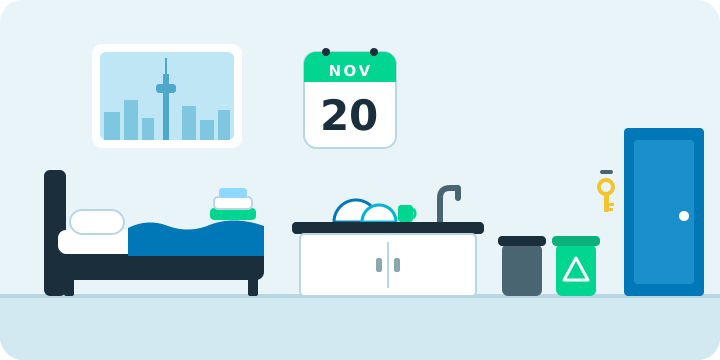
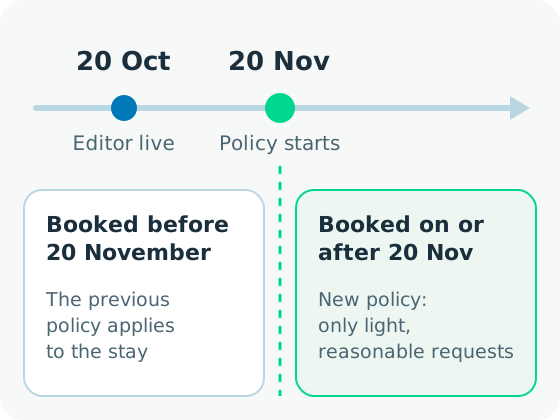
Airbnb set out the changes in its hosting Resource Center on 20 October. Part of it is live already: house rules and checkout instructions now sit together in the listing editor. The limits on what hosts can ask take effect on 20 November 2026 (Airbnb).
The policy covers reservations booked on or after 20 November (Airbnb help centre). Bookings made before then keep the house rules that were on the listing when the guest booked (Rental Scale-Up), and Airbnb's previous policy on contracts and ID still applies to them (Airbnb help centre). Over summer you may have guests booked under both versions. Airbnb's New Zealand help centre carries the same policy and start date with no country carve-outs (Airbnb NZ help centre), so we're treating it as applying to New Zealand listings.
Why Airbnb is doing this
Guests have complained for years about high cleaning fees and long checkout chore lists. In November 2022 Airbnb said checkout requests should be reasonable and shown before booking; stripping beds, doing laundry and vacuuming were the examples of tasks that went too far (FOX 11). This time Airbnb has written it into a formal policy, with set examples and a stated enforcement process.
Airbnb says it has heard from its community that house rules can be "confusing, onerous and hard to manage" (Good Morning America).
Not every host is happy. TechCrunch reports pushback from hosts, including in Airbnb's community forums. One host of 12 years said the change could lead them to withdraw their listing. Some hosts argue that basic cleaning tasks keep properties sanitary and protect them, and that hosts carry the cost of getting a place ready for the next guest (TechCrunch). That's a fair point, and it's exactly the cost this change moves onto hosts.
What you can still ask, and what you can't
These are Airbnb's own examples (Airbnb):
| Fine to ask | Not allowed | |
|---|---|---|
| Dishes | Put used dishes in the sink | Wash them and put them away |
| Beds and laundry | Gather the used towels | Strip the beds or start a load of washing |
| Rubbish | Sort rubbish and recycling into the indoor bins | Take rubbish off the property |
| Air conditioning | Turn it off when leaving | Avoid using it during the stay |
Behind the examples is a simple test: a request can't take significant effort or time, or be work a cleaner would normally do. Advertised features can't be restricted either (Airbnb help centre). Airbnb's example is air conditioning (Airbnb), and we'd read a listed heat pump the same way. Context can make a firmer request reasonable: Airbnb's examples are animal-proof bins in bear country and shorter showers during local drought restrictions (Airbnb help centre).
House rules and requests are now different things
There are seven standard house rules: maximum overnight guests, quiet hours, events, pets, smoking (including vaping), commercial photography and filming, and locking up at checkout, with optional details on where keys go. Guests are required to follow them. If a guest breaks one during the stay, or says before check-in that they plan to, you can cancel without fees or other consequences (Airbnb).
Everything else goes under requests. Guests are encouraged to follow those, not required to, and every request has to meet the new standard.
All of it has to live in one place. Hosts can't add rules or requests outside the house rules section or after booking, whether by message, a sign in the home or in person (Airbnb help centre). A note by the door can still help guests find the bins, but it can't add a rule or a new request.
Fines, contracts, ID and outside reviews
These are the parts most likely to catch hosts out (Airbnb help centre; Airbnb help centre):
- No fines. Hosts can't impose fines or other penalties on guests. If a community association, building security or the council could fine for something, you can warn guests in the listing's designated section instead. For damage, Airbnb points hosts to AirCover for Hosts.
- No fees outside the price. Fees for anything you advertise must be in the price shown at booking. Optional extras (Airbnb's example is breakfast) can be mentioned in requests.
- No separate contracts, unless the law or community association rules require one (Airbnb's examples are homeowners association or building security requirements), it covers an optional extra, the stay is 28 nights or more, or it's an Airbnb Luxe listing.
- No collecting ID or personal details during booking or the stay, unless the law or a documented community association rule requires it, or it's needed to sign one of the allowed contracts. You can check ID in person at check-in if your requests say so, but you can't keep a copy unless one of those exceptions applies.
- Apps and wifi. You can't make guests register with another app or website to get in or use a critical amenity. Keyless-entry apps that need registration are allowed, as long as you offer another way in if a guest asks. Wifi log-in pages that ask for an email address or other personal details aren't, unless the listing is a hotel or resort or one of the exceptions above applies.
- Reviews elsewhere. You can't ask guests to review their Airbnb stay, or fill in a survey, on another website unless the listing is a hotel. We read that as ruling out asking Airbnb guests for a Google review of their stay. This isn't new: Airbnb's previous policy already ruled it out.
Apartments and bodies corporate
Auckland apartments need extra care. In a unit title development, the body corporate's operational rules bind owners and occupiers (Tenancy Services). A body corporate may also require owners to provide guests' details (Duncan Cotterill).
Airbnb's exceptions point the same way. You can warn guests about fines that "a community association (such as an HOA or building security)" could impose, and contracts are allowed where community association rules require them (Airbnb help centre; Airbnb help centre). Airbnb doesn't mention New Zealand bodies corporate. We'd expect it to treat one the same way, but if your building requires guest registration or ID, check with Airbnb how to disclose that before 20 November.
How Airbnb will enforce it
Requests that don't meet the policy are highlighted in the listing editor. Airbnb then emails the host with tips to fix them and a chance to appeal. If nothing changes, guests may see an alert on the listing, such as "includes cleaning requests" (Airbnb). Persistent breaches can bring a notice on the listing page and lower visibility in search (Airbnb help centre). Breaking the contracts and personal-data rules can lead to suspension or removal of the listing, or of the account for repeat offences (Airbnb help centre).
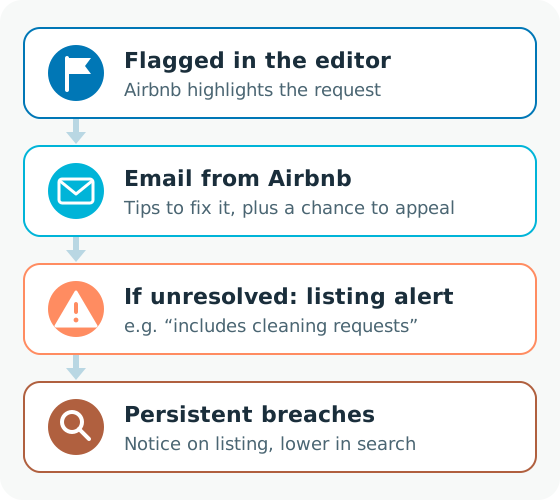
An alert like that sits on your listing where guests can see it, so it can cost bookings before any formal penalty. Airbnb does offer an appeal, but the simpler course is to fix anything it highlights before guests ever see an alert.
What it means for Auckland hosts
If your cleaner already does the full turnover, little changes beyond moving your rules into the editor and rewording a few requests.
If your listing relied on guests doing part of the work, such as stripping beds, running the dishwasher or putting the bins out, that work now falls to you or your cleaner. Ask your cleaner how much time it adds and whether their price changes. If you'll be travelling yourself this summer, we've written about who looks after an Airbnb while you're away.
Bin day is the Auckland grey area. Where the council collects from the kerb, bins go out the night before or before 7am on collection day (OurAuckland). Airbnb lets you ask guests to sort rubbish into indoor bins and rules out taking it off the property, but it doesn't say where wheeling a bin to the kerb falls. We wouldn't build a turnover around guests doing it.
If you're tempted to cover the extra work with a higher cleaning fee, remember guests see it. Since April 2025, Airbnb has shown guests worldwide the total price of their stay, including fees, by default (Airbnb). A bigger fee shows up in the number every guest compares.
Is this a reason not to do short-term rental?
No. But it's a reminder that a short-term rental is a hospitality business, not a passive one. The change bites hardest on listings where guests did part of the turnover, such as smaller places without a cleaner after every stay. If you're weighing short-term against long-term rental, budget for a full professional clean after every stay from the start, not as a later upgrade. If your sums relied on guests doing part of each clean, run them again; what your Airbnb actually earns walks through the costs.
Example, using assumptions rather than real figures. If stripping beds, washing up and taking the rubbish out adds 30 minutes to each turnover, eight turnovers a month means four extra cleaner-hours a month. At an assumed $45 an hour, that's about $180 a month, plus GST if your cleaner charges it. Your real figure depends on the property, the number of beds and your cleaner's pricing.
If the numbers don't work, a long-term tenancy may suit the property better, and we'd tell you so. Our long-term rental vs Airbnb comparison runs both on a central Auckland two-bedroom.
A reminder for every Airbnb host: what to change before 20 November
Whether you host a spare room or several homes, this reaches everyone on Airbnb, and most of it is quick to fix. Old rules and chore lists tend to sit in places you set up once and haven't read since, so check them all:
- Open your house rules in the listing editor and read anything Airbnb has highlighted.
- Read your listing description too, especially "Other things to note". Rules and checkout requests written there need to move into the house rules and requests section (Airbnb).
- Put the rules you'd actually enforce into the seven standard house rules.
- Take out chore requests such as stripping beds, washing up or taking rubbish off the property. Keep light ones, like dishes in the sink, gathering towels, sorting into indoor bins and locking up.
- Remove fines and penalties, and move any building or council fine warnings to the listing's designated section.
- Drop any separate agreement, ID upload, wifi sign-up or request for an outside review unless an exception applies.
- Update your saved and scheduled messages, especially the checkout reminder, plus your welcome book, guidebook and any signs in the home. None of them can add a rule or ask for a task Airbnb now rules out.
- Agree the extra turnover tasks with your cleaner before the first bookings under the new policy arrive.
We'd make these changes now rather than on the 19th. The lighter wording works just as well for guests who booked earlier, and it's one less job in a busy summer. This is Airbnb's policy; Booking.com and Vrbo set their own rules, so if you list on more than one platform, check each.
Quick answers
Can Airbnb hosts fine guests?
For stays booked from 20 November 2026, Airbnb's policy says hosts can't impose fines or other penalties. They can warn guests in the listing about fines a community association, building security or the council could impose (Airbnb help centre).
Can I ask Airbnb guests to put the bins out on collection day?
Airbnb lets you ask guests to sort rubbish into indoor bins but rules out taking it off the property, and it doesn't say whether wheeling a bin to the kerb counts. We wouldn't rely on it.
Where we fit
We manage short-term rentals for Auckland owners. For the owners we work with, that means house rules written to each platform's own policy, a professional clean triggered automatically at every checkout, and laundry handled professionally, so stripping beds and washing up never rest on guests. If you'd like to know what your property could earn with that handled, our free appraisal comes back within 2 business days with a realistic revenue range. If short-term letting doesn't suit your property, we'll say so.
Important. This article is general information only, current at 22 October 2026. It summarises Airbnb's published policy and news reports, isn't financial, tax or legal advice, and doesn't take your circumstances into account. Airbnb applies the policy case by case and may change it. Heron Living manages short-term rentals for a fee.
Sources
Airbnb, “Important changes to house rules”, hosting Resource Center, 20 October 2026.
Airbnb help centre: “Reasonable house rules and requests” and “Limiting host-imposed contracts and other requirements”, both applying to reservations booked on or after 20 November 2026; and the New Zealand edition of “Reasonable house rules and requests”.
Uvika Wahi, “Airbnb's new house rules policy: what hosts can and can't ask guests to do from November 20”, Rental Scale-Up, 21 October 2026.
Lauren Forristal, “Airbnb limits chores for guests, sparking backlash from hosts”, TechCrunch, 21 October 2026.
Shafiq Najib, report on Airbnb's new limits on checkout chores, Good Morning America, 21 October 2026.
Airbnb Newsroom, “Total price display is now standard for guests worldwide”, 21 April 2025.
Kelly Hayes, report on Airbnb's 2022 pricing and checkout announcement, FOX 11 Los Angeles, 8 November 2022.
Tenancy Services (Ministry of Business, Innovation and Employment), Body Corporate Operational Rules (guide), March 2014, accessed 22 October 2026.
Hannah Brown, “Airbnb in unit titles: what you can – and can't – do”, Duncan Cotterill, 25 March 2026.
Auckland Council, “Recycling, rubbish and food scraps collection days change”, OurAuckland, 18 June 2024.