
General information only, not financial, tax or legal advice. Unit title law turns on the exact rules and facts of each building. If your body corporate is changing its rules, or you're in a dispute, talk to a lawyer who works in this area.
What happened at The Point
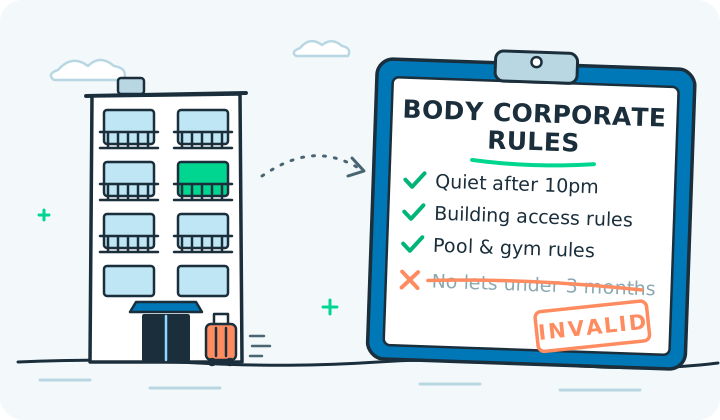
The body corporate for The Point Apartments, at 121 Customs Street West, passed the rule at its annual general meeting on 11 September 2019. It said no owner or occupier "may let, rent, or licence his or her unit for a period of less than 3 months" (Tenancy Tribunal order).
The body corporate's witnesses gave its reasons. One said short-term letting "increases traffic, noise and likelihood of potential damage to common areas". The building's facilities manager said it would turn his role into that of an active "hotelier" and raised security concerns. The Tribunal didn't accept those reasons as enough. It said it needed more than "potential but otherwise unsubstantiated claims" of damage, noise, security and facility use (Tenancy Tribunal order, paras 24–25).
The decision rested on three points:
- No power to make it. The Tribunal found "no power in the UTA or the Regulations" that the rule could be derived from or incidental to. Operational rules have to hang off a power or duty the Unit Titles Act already gives the body corporate.
- It cut across owners' rights. The rule "encroaches upon the unit owners' right to lease their unit for however long or short as they see fit", and interfered with their quiet enjoyment.
- It didn't fit the problem. "A ban on leasing units for less than three months does not address the so-called problems identified by the body corporate." Problems should be dealt with by addressing the conduct complained of.
The Tribunal relied on earlier High Court decisions that struck down rules restricting how owners could lease their units, including Russell Management Ltd v Body Corporate 341073 (2008) and Wu v Body Corporate 366611 (2011), as the order describes them (Tenancy Tribunal order, paras 11–16).
Property management firm Prop101 summarised the case at the time (Prop101).
Two limits are worth keeping in mind. This was a Tenancy Tribunal decision on one building's facts, not a ruling from a higher court, and the rule it struck down was a three-month minimum rather than a rule that named Airbnb. As Duncan Cotterill puts it, "Tribunal decisions depend heavily on the facts of each case" (Duncan Cotterill).
Can a body corporate ban short-term letting under the Unit Titles Act?
Every unit title development has operational rules. Tenancy Services' guide says changes to them must relate to the control, management, use or enjoyment of the units or common property, or to how the body corporate is run. They can't give the body corporate powers that aren't "incidental" to the ones it already has, and they can't be inconsistent with the Act or other law. A change needs an ordinary resolution, and has to be lodged with Land Information New Zealand to take effect (Tenancy Services).
Lawyers who work in this area read that the same way:
- Rainey Collins: "A Body Corporate cannot prohibit short-term leasing under their rules as this would not be 'incidental to' a power under the Act" (Rainey Collins).
- Crockers: "Attempts to ban AirBnB outright are rare and often unsuccessful" (Crockers).
- Duncan Cotterill: rules that try to completely prohibit leasing "may not be enforceable", and "Airbnb isn't automatically allowed or banned in unit title developments" (Duncan Cotterill).
- Body corporate specialist Liza Fry-Irvine told LawNews she cautions body corporate clients against adding rules that prohibit short-term accommodation where planning rules allow it, because recent tribunal decisions suggest such rules go beyond a body corporate's powers (interest.co.nz).
"Usually can't ban it" isn't the same as "anything goes". The same sources are clear that the body corporate can still regulate how guests use the building, and that owners have to follow those rules.
What the rules can still control
The Point decision itself gave an example. A rule banning music from loudspeakers between 10pm and 7am "could be said to be intra vires", because it links to the default rule on noise (Tenancy Tribunal order, para 35). That's the pattern: rules that target conduct tend to stand, and rules that target a type of owner or letting tend not to.
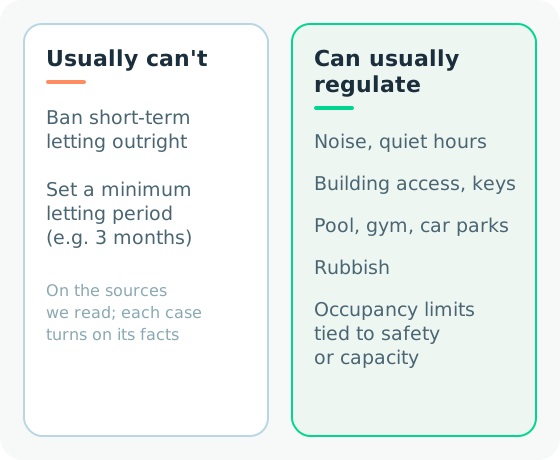
Law firm Duncan Cotterill and body corporate manager Crockers list the areas operational rules commonly cover for short stays (Duncan Cotterill; Crockers):
| Rule area | What it means for a short-term rental |
|---|---|
| Noise and quiet hours | Your listing's quiet hours should match the building's |
| Building access | Rules on keys, swipe cards and building security decide how guests get in |
| Guest registration | Some buildings ask for guests to be registered with the building manager. Duncan Cotterill notes that providing guests' details can be an onerous, ongoing obligation |
| Shared facilities | Pool, gym and car park rules apply to guests too, so don't advertise what guests can't use |
| Rubbish | Where it goes and when, which your cleaner needs to know |
| Occupancy limits | Can apply where they're tied to safety or building capacity, and cap your maximum guests |
If guests break the rules, Duncan Cotterill says, "responsibility will often sit with you" as the owner. Whether a body corporate can fine you for it is less clear. Crockers' guidance says a body corporate may fine owners or take enforcement action, while Fry-Irvine told LawNews that the fines many bodies corporate tried to impose weren't legally enforceable under the Act (Crockers; interest.co.nz). We'd treat that as unsettled and not plan around either view.
Airbnb's own policy lines up with this. For bookings from 20 November 2026 hosts can't fine guests, but they can warn guests, in the designated section of the listing, about fines a community association or building security could impose (Airbnb help centre). A documented community association rule, such as a building security requirement, is one of the exceptions that allow collecting guest details, as long as the listing says what's needed and why, and no more is collected than the rule requires (Airbnb help centre). We covered that in Airbnb's new house rules.
The checks that matter more than a ban
Even where a ban wouldn't stand, the building, the insurance or the lending can still make short stays a poor fit. Before you list an apartment, we'd work through these:
- The current rules and recent minutes. Read the operational rules registered for the development, then the last AGM minutes. Minutes show whether a rule change, a security levy or a dispute about short stays is coming.
- The building's insurance. Rainey Collins notes that short-term letting may lead to higher building insurance premiums, which raise levies for every owner (Rainey Collins). Ask the body corporate whether its insurer knows units are let short term, and check your own contents and landlord cover separately.
- Your mortgage. Lending terms may require you to tell your bank how the property is used (Duncan Cotterill).
- Council rules. These vary by address and can include consent or rating consequences, and a change of use can bring building work such as fire safety (Duncan Cotterill). In Auckland, rates change with the number of nights you let; see Auckland Council rates for short-term rentals.
- Management agreements. In mixed-use buildings where some units are run as accommodation, there may be contracts covering management rights (Tenancy Services). Find out whether your unit is tied to one before you plan anything else.
- The mood of the building. At The Point, the rule passed by ordinary resolution at the AGM. The Tribunal called the majority's view of "not having to put up with short-term renters residing in their midst" simplistic, but the vote still happened. A building where many owners oppose short stays is a harder place to host, even if a ban wouldn't stand.
When an apartment isn't the right fit
Some apartments suit short stays well: a central location, easy access, a building manager used to visitors. Others don't. If guest access means swipe cards that can't be handed over, the building's insurance excludes short-term letting, or you'd be in a running dispute with your neighbours, a long-term tenancy may be the better answer for that property, and we'd tell you so. Our long-term rental vs Airbnb comparison runs both options on a central Auckland two-bedroom.
Quick answers
Can a body corporate ban Airbnb in New Zealand?
On the sources we read, generally not outright. In 2020 the Tenancy Tribunal struck down a rule at The Point Apartments in Auckland that banned lets of less than three months, and lawyers who work in this area say a rule prohibiting short-term letting may not be enforceable. Each case turns on its facts.
Can a body corporate set rules for Airbnb guests?
Yes. Rules on noise, building access, shared facilities, rubbish and safety-related occupancy limits apply to guests as well as residents, and owners are often responsible when guests break them.
Can the body corporate fine me for my guests?
The sources disagree. Some body corporate guidance says fines are possible; a specialist quoted in LawNews said many fines weren't legally enforceable. If you get a fine notice, get advice on that building's rules.
Where we fit
We manage short-term rentals for Auckland owners. If you'd like a second opinion on whether your apartment suits short stays, and what it could earn, our free appraisal comes back within 2 business days with a realistic revenue range. If the building's rules, insurance or neighbours make short stays a poor fit, we'll say so.
Important. This article is general information only, current at 1 November 2026. It summarises a Tenancy Tribunal decision, Tenancy Services guidance and law-firm commentary. It isn't financial, tax or legal advice and doesn't take your circumstances into account. Heron Living manages short-term rentals for a fee.
Sources
Tenancy Tribunal, order in Housley and others v Body Corporate 199318, [2020] NZTT Auckland 9018322, 5 November 2020 (copy published by Prop101).
Prop101, “Tenancy Tribunal decision on short term accommodation”, Katie Forsman, 4 December 2020.
Tenancy Services (Ministry of Business, Innovation and Employment), Body Corporate Operational Rules (guide), March 2014, accessed 1 November 2026.
Hannah Brown, “Airbnb in unit titles: what you can – and can't – do”, Duncan Cotterill, 25 March 2026.
Rachel Collins, “Body Corporates and short-term leasing”, Rainey Collins Lawyers, accessed 1 November 2026.
Crockers, “Can a Body Corporate Restrict AirBnB in New Zealand?”, 26 September 2025.
Airbnb help centre: “Reasonable house rules and requests” and “Limiting host-imposed contracts and other requirements”, applying to reservations booked on or after 20 November 2026.
Neil Sands, “Body corporate rules – where's the line between reining in 'ferals' and riding roughshod?”, interest.co.nz (from LawNews), 16 September 2026.